How many homeless people are in the US? What does the data miss?
Of the 745,652 people experiencing homelessness in January 2025, white adults ages 35 to 44 represented the largest demographic group.
Nearly 22 out of every 10,000 Americans — 745,652 people — experienced homelessness in January 2025 according to the Department of Housing and Urban Development (HUD) annual point-in-time report, which measures homelessness across the US on a single night each winter. That’s a 3.3% decrease from 2024’s count.
The total homeless population in the US fell 3.3% from 2024 to 2025.
Total homeless population, overall and by sheltered status, 2007–2025

How is homelessness defined?
HUD’s definition includes both sheltered and unsheltered people. Sheltered people are living in some kind of temporary housing: emergency shelters, transitional shelters, safe havens serving people with severe mental illness, or hotels/motels. Unsheltered people are living outdoors, in cars, in encampments, in abandoned buildings, or in other places deemed unfit for human habitation.
People staying with friends are considered homeless if they can’t stay longer than 14 days, but this population isn’t included in HUD’s dataset.
Get weekly insights
Subscribe for data-driven insights. No spin, just the facts.
Who is homeless in America?
People experiencing homelessness have a variety of characteristics across racial and ethnic identities, by age bracket, and by veteran status.
How does homelessness vary by race or ethnicity?
Over 270,000 of 2025’s homeless population — 36.7% of unhoused people in the US, the largest group of unhoused people — identified as white. White people were 72.3% of the US population that year. People who identified as either Black, African American, or African were 32.7% of the homeless population and 13.5% of the population overall.
Native Hawaiians and Pacific Islanders had the highest rate of homelessness: 99.9 people per 10,000. This rate may be, in part, a result of the high cost of living in Hawaii — in 2024, it had one of the highest rates of “housing-burdened” people (people spending more than 30% of their income on rent or mortgage payments).
The homelessness rate among Native Hawaiians and other Pacific Islanders is 4.6 times higher than the US average.
Homeless population per 10,000 people by race and ethnicity, 2025

What age are most people experiencing homelessness?
In 2025, 21.7% of the unhoused population were ages 35 to 44, the largest of any age bracket despite being only 13.3% of the US population. People over the age of 64 were 6.0% of the unhoused, the lowest share by age bracket, and accounted for 18.9% of the population.
(Homelessness also impacts life expectancy; according to the US Interagency Council on Homelessness, unhoused people in the US have an average life expectancy of 50, compared to 77 for the average US resident.)
How many veterans are homeless?
The US also has a homeless veteran population, though this group declined from 73,367 in 2009 to 32,495 in 2025. The overall veteran population also shrank from 21.9 million in 2009 to 15.7 million in 2024. Programs such as the HUD-Veterans Affairs Supportive Housing program (VASH) to help vets find permanent housing and access healthcare. The Department of Veteran Affairs states that HUD has approved over 116,000 VASH vouchers to assist eligible veterans with housing rental payments since 2008.
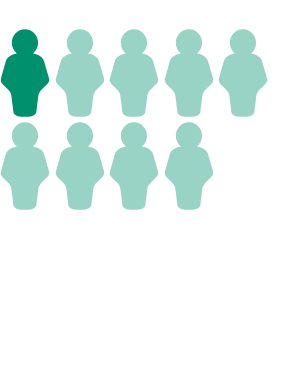
The veteran homelessness rate has decreased by more than one-third since 2010.
Veteran homeless population per 10,000 veterans, 2009–2025

How has the homeless population changed over time?
The total homeless population generally went down from 2007 to 2016 before rising from 2017 to 2024; it went up 12.1% in 2023 and another 18.1% in 2024 before dropping 3.3% in 2025. The US Interagency Council on Homelessness attributes the increases to inadequate systems for making sure people have access to affordable housing, wages, health care, and economic opportunity.
Homelessness looks very different across states and cities and towns, and the Government Accountability Office (GAO) found that rising rents and job losses, which can vary significantly at the local level, contribute to homelessness. Policies regarding encampment and shelter restrictions along with personal circumstances like poverty or domestic violence also impact homelessness rates.
How is this data collected, and who does it miss?
HUD has separate homelessness counts for sheltered and unsheltered people. Both counting methods have flaws that may lead to underestimates.
Unsheltered people
An annual point-of-time count of unsheltered people (an unduplicated count, on a single night, of all the homeless people in the US) happens in the last week of January. HUD chose January because it has the highest shelter use, so it assumes a more complete count of people experiencing long-term unsheltered homelessness vs. those who use shelters intermittently.
Localities approach point-in-time counts differently. Many use a public places count, where volunteers and workers visit locations where homeless people are believed to congregate. Police officers are sometimes used to help identify locations or access potentially dangerous areas like abandoned buildings.
There are several drawbacks of public place counts. First, they rely on a list of places where homeless people are known to gather, which could lead to an undercount. People living in cars or checking in and out of motels may be missed. People may also deliberately hide to avoid the count, and some people may be less forthcoming about their living situations in the face of a police presence.
Other localities take a service-based approach, basing their counts on use of food pantries, soup kitchens, social service agencies, and other non-shelter services. This requires significant screening on the part of the counters to make sure they’re only identifying homeless individuals, and it misses the people who never use these services.
Sheltered people
Homeless people in shelters are easier to track because they more consistently interact with government resources. The Homeless Management Information System tracks the characteristics of people using services such as emergency shelters and transitional housing. Some localities also supplement this data with surveys.
Sheltered counts offer more consistent data but aren’t without challenges: Rural service providers struggle with understaffing, poor technology infrastructure, communication, and transportation over large geographical areas. Sheltered counts also exclude people staying with family or friends, children in emergency foster care and detention facilities, and adults in criminal justice facilities.
Counting homeless individuals is difficult, but a 2020 report from the GAO recommended more regular quality checks of data collection methods as a way to improve accuracy.
Where does this data come from?
Where does this data come from?
Data in this article comes from an annual report that the Department of Housing and Urban Development (HUD) provides congress on homelessness and housing. Numbers are based on point-in-time counts in January each year. Data is collected by local planning bodies (known as “Continuums of Care” or CoCs) that train people to physically survey their community for the count in all 50 states, Washington, DC, and US territories.
Read more about the states and cities with the highest homelessness rates, and get the facts every week by signing up for our newsletter.

Keep exploring
- Which US cities have the largest homeless populations? - In 2025, over a quarter of people experiencing homelessness in the US were concentrated in two major cities: New York, NY, and Los Angeles, CA.
- What is the poverty rate in the US?
- How is the standard of living changing for veterans? - Veterans in the US earn higher incomes and have lower unemployment and poverty rates than the general population.
- Which states have the highest and lowest rates of homelessness? - New York and Oregon have the highest US homelessness rates. Over five years, rates rose in all but four states and Washington, DC.

